Form Tracking and Call Tracking in One Dashboard
Track form submissions alongside phone calls with the same source attribution. The tracking.js snippet captures form fills with UTM, gclid, and fbclid data. Forward form leads via email or webhook. See every lead in one place.
The bottom line
Last updated: February 2026CallScaler's form tracking captures form submissions with the same source attribution as phone calls, using the same tracking.js snippet. Every form fill is logged with UTM parameters, gclid, fbclid, and landing page data. Form leads can be forwarded via email or webhook and appear alongside calls in the dashboard. This gives agencies and lead gen companies a single view of all inbound leads without needing a separate form tracking tool.
How it works
One script tracks both calls and form submissions.
Add the Tracking Script
The same tracking.js snippet that powers DNI also captures form submissions on your site.
Configure Form Rules
Tell CallScaler which forms to track. Target by CSS selector, form ID, or track all forms automatically.
Forms Captured with Attribution
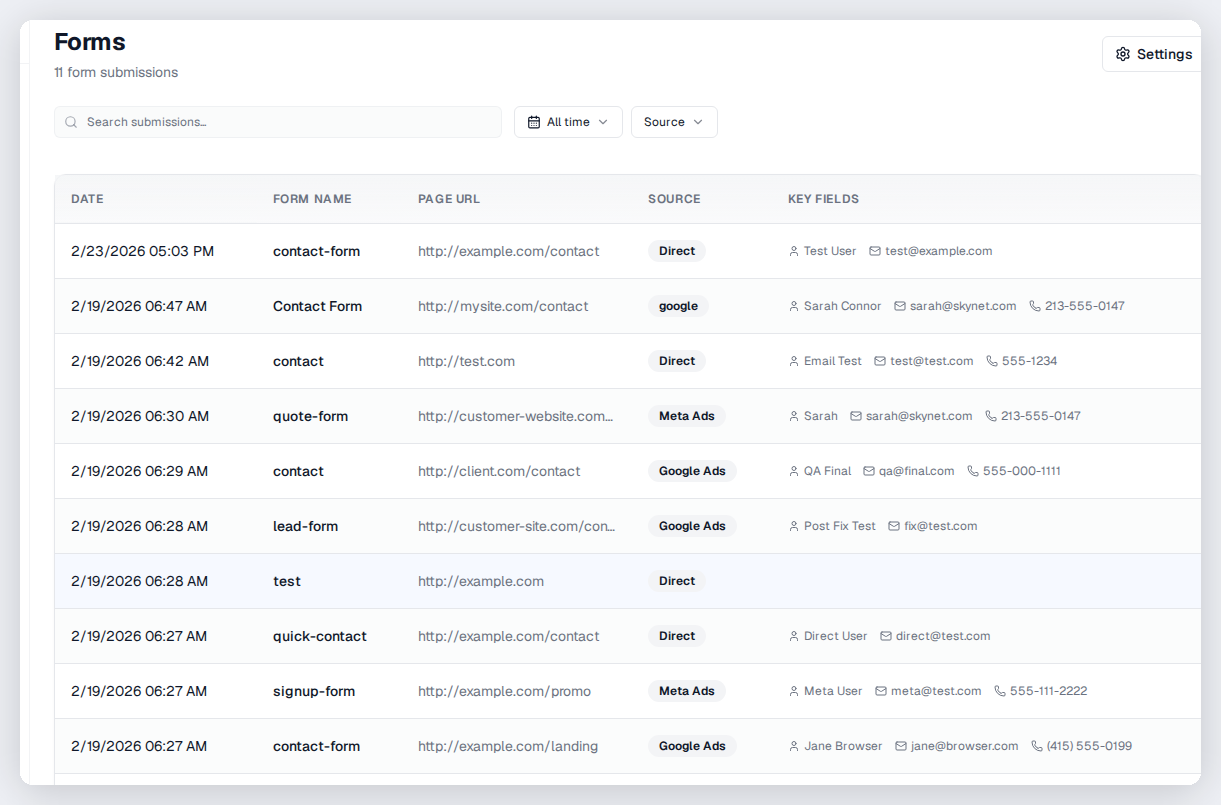
Every form submission is logged with the visitor's source, UTM parameters, gclid, fbclid, and landing page.
Forward and Report
Form data is forwarded via email or webhook. See forms alongside calls in your dashboard.
Key capabilities
Complete lead attribution across every conversion type.
Automatic Form Detection
Track all forms on your site automatically, or target specific forms by selector or ID.
Source Attribution
Every form fill is tagged with the same UTM, gclid, and fbclid data as your calls.
Email and Webhook Forwarding
Forward form submissions to any email address or webhook endpoint in real time.
Unified Dashboard
See form leads and call leads side by side. One view of all your inbound leads.
Form Rules
Control which forms are tracked, which fields are captured, and where data is forwarded.
No Extra Code
The same one-line tracking.js snippet handles both DNI and form tracking. No additional setup.
Try Form Tracking free
No credit card required. Set up in under 60 seconds.
Who uses form tracking?
Marketers and agencies that generate leads through both phone calls and form submissions.
Why track forms and calls together?
Most lead gen businesses generate leads through both phone calls and form submissions. If you track these separately, you get an incomplete picture of which campaigns actually work. A campaign might look like it has low ROI based on call data alone, but when you add form submissions from the same source, the numbers tell a different story. CallScaler's form tracking uses the same attribution data as call tracking, so you see all leads from every source in one dashboard.
How form tracking captures attribution data
The same tracking.js snippet that powers DNI also monitors form submissions on your site. When a visitor fills out a form, CallScaler captures the submission along with UTM parameters, gclid, fbclid, landing page URL, and the visitor's referral source. This means every form lead gets the same source attribution as a phone call. You configure which forms to track by CSS selector, form ID, or simply track all forms on the page automatically.
Forwarding form data to your team
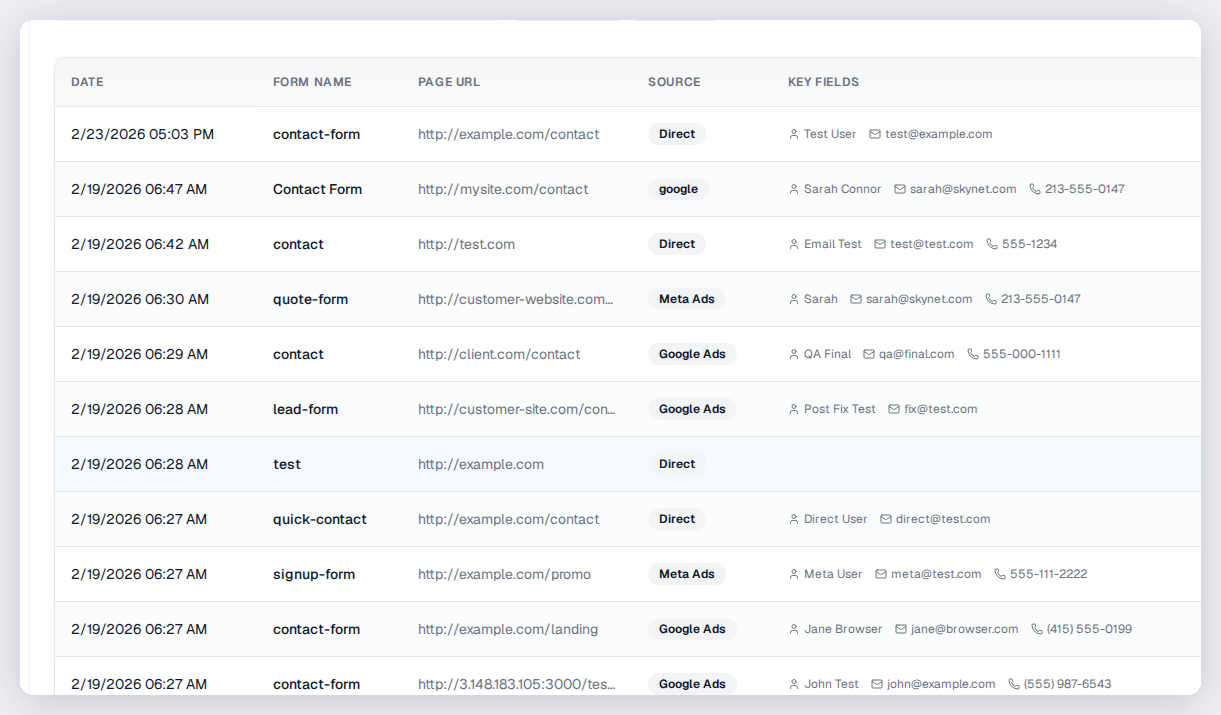
Form submissions can be delivered to your team through multiple channels:
- Email forwarding sends form data to any email address in real time
- Webhook delivery pushes JSON payloads to your CRM or automation platform
- Zapier integration connects form events to 5,000+ apps without code
- Dashboard view shows all form submissions alongside calls in one timeline
- CSV export lets you download form data for offline analysis or reporting
Common form tracking patterns
Here are the most effective ways agencies and lead gen companies use form tracking:
- Track contact forms and call conversions from the same Google Ads campaign
- Compare form lead quality vs call lead quality by source to optimize spend
- Forward form submissions to client CRMs while keeping attribution in CallScaler
- Use form plus call data together when reporting total lead volume to clients
- Set up webhook forwarding to trigger instant Slack notifications for form leads
Tips for accurate form tracking
Make sure your forms have unique identifiers (IDs or class names) so you can target specific forms if needed. If your site uses multi-step forms, CallScaler captures the final submission. For forms loaded dynamically via JavaScript frameworks like React or Vue, the tracking script handles these automatically since it monitors DOM changes. Test form tracking after setup by submitting a test form and checking that it appears in your CallScaler dashboard with the correct source attribution.
Comparing form leads vs call leads
With both form and call tracking in CallScaler, you can compare lead quality across conversion types. Many businesses find that phone calls convert to sales at 2-3x the rate of form submissions, but forms generate higher volume. Use this data to balance your marketing mix and set appropriate cost-per-lead targets for each conversion type.
Form tracking for multi-location businesses
Handle form tracking across multiple sites and locations:
- Deploy the same tracking.js snippet across all location pages for consistent attribution
- Use CSS selectors to track location-specific forms separately
- Route form submissions to different email addresses per location via forwarding rules
- Compare form volume and quality across locations in the analytics dashboard
Automating form lead follow-up
Combine form tracking with webhooks to trigger instant follow-up. When a form submission comes in, a webhook fires with the form data and source attribution. Use Zapier to create a CRM lead, send a Slack notification to the sales team, and trigger an automated email response — all within seconds of the form submission. Speed-to-lead is critical, and automation ensures no form lead waits for a manual check.
Frequently asked questions
Common questions about Form Tracking.
Related features
Works great with Form Tracking.
Dynamic Number Insertion
One line of JavaScript. Every website visitor sees a unique tracking number based on how they found you — Google Ads, Facebook, organic, or direct. Visitor-level attribution without changing your site.
Learn moreKeyword-Level Tracking
Capture gclid, msclkid, fbclid, and UTM parameters automatically. Know which keywords, ad groups, and campaigns generate phone calls — and feed that data back to your ad platforms for smarter bidding.
Learn moreWebhooks & Zapier
Get real-time webhook events for every call — start, end, voicemail, and qualification. Connect to Zapier, your CRM, Slack, or any system that accepts HTTP callbacks. Build any automation you can imagine.
Learn moreReady to try Form Tracking?
Sign up free and get started in under 60 seconds. No credit card required.